

Author: Anna Pluta
Program of the 2nd conference “Corruption, Tax Evasion and Institutions” is now available
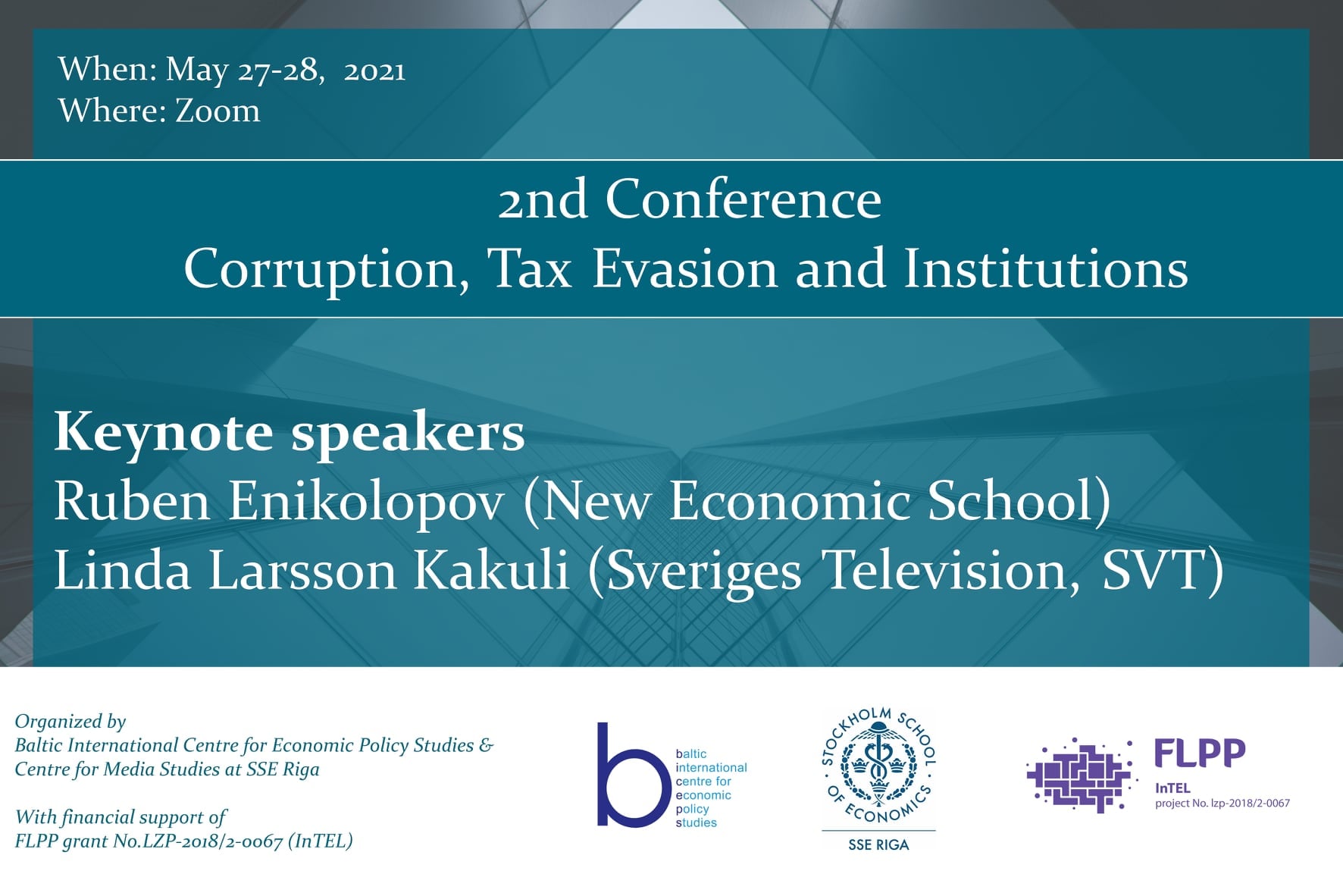
2nd conference “Corruption, Tax Evasion and Institutions” will take place on May 27-28, 2021. The conference will be held online. Program of the conference is now available. Read more about the conference.
Programme of the 2nd conference “Corruption, Tax Evasion and Institutions”
| 11:00 – 11:10 | Conference opening
Anders Paalzow, Rector of SSE Riga and director of BICEPS |
| 11:15 – 12:15 | Session 1 |
| Chair: Marc Sangnier (University of Namur)
Betrayed by the Elites: How Corruption Amplifies the Political Effects of Recessions Carlos Sanz (Bank of Spain), Albert Solé-Ollé, Pilar Sorribas-Navarro Polarized Social Norms Against Corruption: A Social Media Experiment in India Jun Goto (Kobe University), Takashi Kurosaki, Yuko Mori |
|
| 12:30 – 13:30 | Session 2 |
| Chair: Pilar Sorribas-Navarro (Universitat de Barcelona & IEB)
Corruption under Austerity Tommaso Giommoni (ETH Zurich), Gianmarco Daniele Interest Groups’ Contributions, Political Selection and the Quality Incumbency Advantage: Evidence from Brazil Julieta Peveri (Aix-Marseille University) |
|
| 14:30 – 15:30 | Session 3 |
| Chair: Zareh Asatryan (ZEW, Mannheim)
Tax Evasion and the Minimum Wage Anikó Bíró (Centre for Economic and Regional Studies), Dániel Prinz, László Sándor What we pay in the shadow: Labor tax evasion, minimum wage hike and employment Nicolas Gavoille (SSE Riga), Anna Zasova |
|
| 15:45 – 16:45 | Session 4 |
| Chair: Audinga Baltrunaite (Bank of Italy)
VAT Rates and Tax Evasion: Evidence from the Restaurant Industry in Greece Nikolaos Artavanis (Virginia Polytechnic and State University) Monitoring the Monitors: Auditors, Corporate Theft, and Corruption Maxim Mironov (IE Business School) |
|
| 17:00 – 18:00 | Keynote I: Linda Larsson Kakuli (Sveriges Television, SVT)
Title: Data analysis and in-depth investigations – two crucial factors to detect suspected money laundering Chair: Nicolas Gavoille (SSE Riga, BICEPS) |
Day 2, Friday, May 28, 2021, Riga time (CET + 1)
| 11:15 – 12:15 | Session 5 |
| Chair: Boris Ginsburg (Universidad Carlos III de Madrid)
Crony Capitalism as an Electoral Outcome Dmitry Veselov (HSE University) Brains and Muscles? A Political Economy of Tax Evasion Alberto Parmigiani (London School of Economics), Arduino Tomasi |
|
| 12:30 – 13:30 | Session 6 |
| Chair: Mihails Hazans (University of Latvia)
Size, heterogeneity and distributional effects of self-employment income tax evasion in Italy Francesco Figari (University of Insubria), Martina Bazzoli, Paolo Di Caro, Carlo V. Fiorio, Marco Manzo Million Dollar Baby: Should Parental Benefits Depend on Wages When the Payroll Tax Evasion is Present? Vitalijs Jascisens (HSE University), Anna Zasova |
|
| 14:30 – 15:30 | Session 7 |
| Chair: Anna Zasova (BICEPS)
Inter-temporal Shifting of Corporate Income: Evidence from Administrative Tax Return Data Ján Palguta (Carlos III University of Madrid), Jaroslav Bukovina, Tomáš Lichard, Branislav Žúdel The Indirect Effect of Import Competition on Corporate Tax Avoidance Baptiste Souillard (Université Libre de Bruxelles and ECARES) |
|
| 15:45 – 16:45 | Session 8 |
| Chair: Anders Olofsgård (SITE, Stockholm School of Economics)
Why Governments Grow “Lemons” in the Market for Technology Natalia Lamberova (Georgia Tech) The impact of Presidential appointment of judges: Montesquieu or the Federalists? Sultan Mehmood (New Economic School) |
|
| 17:00 – 18:00 | Keynote II: Ruben Enikolopov (New Economic School), Alf Vanags memorial lecture
Title: Tax Evasion of Politically Connected Firms Chair: Nicolas Gavoille (SSE Riga, BICEPS) |
| 18:00 – 18:15 | Closing remarks – Anders Paalzow, Rector of SSE Riga and director of BICEPS |
What a manager wants: how return migrants’ experiences are valued by managers in the Baltics

New SSE Riga/BICEPS occasional paper by Zane Varpina (SSE Riga, BICEPS) and Kata Fredheim (SSE Riga, BICEPS).
This work was supported by the National Research Program Project grant number VPP-IZM 2018/1-0015 and by the Latvian Council of Science, project No. lzp-2018/1-0486.
Abstract.
In the past two decades, the three Baltic countries lost a significant portion of their population. A combination of low birth rates, aging population, and emigration contributed to the decline. In the Baltics, similarly to other Central and Eastern European countries, return migration is often portrayed as the magic solution to improve the countries’ demographic trends, to reverse brain drain, and a way to turn migration into a source of net human capital gains. Policymakers and businesses may be responding to demographic shifts based on hunches. The lack of recent research contributes to the myths around returnees, entrepreneurs, and employers’ attitudes. Finding and staying in employment is key in attracting and retaining return migrants. Yet, how experience from abroad is valued in the labour market is a missing piece in the puzzle.
This paper explores if and which foreign experiences are valued by managers in the Baltics. We present some of the first results of a large-scale, three-year Pan-Baltic study on return migration and brain gain. Using granular data from 67 interviews with managers and entrepreneurs in the three Baltic countries highlights manager’s views on the value of experiences of return migrants. Thus, the study fills a gap in the existing literature and looks beyond statistics to explore narratives and experiences. The data about the now and plans for the future could help policymakers and the business community. Through this research, we learn about the experiences of employers and business owners; to help respond to today’s opportunities and challenges.
Keywords: Return migration, Human capital, Baltics
Women’s Political Empowerment in Latvia

Women in Politics: Why Are They Under-represented? A new FROGEE policy brief on the situation in the region, containing an overview of the situation in Latvia written by Dominik Gerber (SSE Riga, BICEPS).
In spite of favorable historical and institutional predispositions, political executives and assemblies in Latvia fail to reflect the gender diversity of the population they represent. In this brief, I sketch three broad accounts that contribute to the explanation of this outcome. They pertain to the persistence of a gender gap in political ambition , to obstacles hampering the nomination of women in electoral ballot lists, and to structural impediments within the Latvian p arty system after 1991. I conclude by recommending a set of policy measures obstacles, highlighting the absence of binding, legally anchored, commitments to the targeting these political empowerment of women.
The full Report on the situation in Latvia is available here.
Reports from Armenia, Belarus, Georgia, Poland, Ukraine and Russia are available in English and the national languages here.
About FROGEE Policy Briefs
FROGEE Policy Briefs is a special series aimed at providing overviews and the popularization of economic research related to gender equality issues. Debates around policies related to gender equality are often highly politicized. We believe that using arguments derived from the most up to date research-based knowledge would help us build a more fruitful discussion of policy proposals and in the end achieve better outcomes.
The aim of the briefs is to improve the understanding of research-based arguments and their implications, by covering the key theories and the most important findings in areas of special interest to the current debate. The briefs start with short general overviews of a given theme, which are followed by a presentation of country-specific contexts, specific policy challenges, implemented reforms and a discussion of other policy options.
Disclaimer: Opinions expressed in policy briefs and other publications are those of the authors; they do not necessarily reflect those of the FREE Network and its research institutes.
Paper submission deadline for the 2nd conference “Corruption, Tax Evasion and Institutions”
We would like to remind you that the deadline for submission of papers to the 2nd conference “Corruption, Tax Evasion and Institutions” is Sunday, January 31. Click here for more information.
Economic Integration of the Nordic-Baltic Region through Labour, Innovation, Investments and Trade (LIFT) (2021 – 2023)


Baltic International Centre for Economic Policy Studies (BICEPS) is a partner in the Nordic-Baltic integration project LIFT
BICEPS is participating in the Baltic Research Program project “Economic Integration of the Nordic-Baltic Region through Labour, Innovation, Investments and Trade” (LIFT) funded by the European Economic Area (EEA) countries (Iceland and Lichtenstein) and Norway grants for the period 2014–2021.
The aim of the project is to identify in a unified framework how transnational regional integration has contributed to economic development and growth in the Nordic-Baltic Region. What are the associated challenges and lessons to learn for future policy design? The acronym LIFT reflects our main hypotheses: the integration in the Nordic-Baltic Region has lifted the local economies and contributed to a more efficient resource allocation. The LIFT project consists of four closely linked work packages (WP) with the 1st letters of their titles forming the acronym, each of the WP’s focusing on a particular aspect of integration.
- Labour market developments in the context of digitalisation and social change
- Innovation and technology transfers
- Foreign direct investments and capital mobility
- Trade of commodities and services
BICEPS will mainly contribute to work package 1 and 3. Both working packages will require the use of very large administrative datasets combined with advanced quantitative methods. BICEPS researchers will bring their expertise and experience implementing large scale econometrics projects.
WP1 focuses on the recent and rapid labour market developments (including consequences of the COVID-19 pandemic), which create new challenges for employees and employers, generate new forms of labour, changes in working conditions and in the structure of the labour force. This in turn calls for development of legal regulations and human capital, adjustment with cultural challenges as well as enlarge possibilities for the integration of people from different countries and with different ethnicities. This includes studying job flows and worker flows between sectors and between firms and identifying the main characteristics (including personal traits, cognitive and non-cognitive skills) of people switching to the new labor forms, as well as firms experiencing substantial inflows or outflows of workers after the pandemic. In particular, what kind of workers and in which sectors were switching to work from home? Was there a reversal after the pandemic?
WP3 is motivated by how Nordic FDI and public grants in the Baltics contribute to integration of the Nordic-Baltic Region over the last three decades. Norwegian FDI in the Baltics reached 2.5 billion euro in 2016. Nordic FDIs and grants may induce positive impulses and distributional impacts on the Baltic economy, enhancing productivity, labor market performance, social welfare and public service provision. Performance of Nordic-Baltic firms will be benchmarked with that of domestic firms and firms of other international consolidations with investors in countries of similar development. We investigate how Norwegian ownership in Baltic firms affects the performance of Baltic subsidiaries and Nordic mother companies and thereby aggregate income. Further, we will study the impact of FDI on wage gaps and labor composition (occupations and education) and mobility of employees between/within consolidations. The aim is to investigate how human resource policy (e.g. cultural traits of investors) are affected by firm being purchased by a foreign entity.
The project period runs from 2021 until the end of 2023.
The research consortium is led by Vilnius Gedimina’s Technical University of Lithuania. Other research partners are the University of Tartu in Estonia, the University of Latvia, and Institute of Transport Economics in Norway. In addition, the project has five stakeholder partners – Export Credit, the Nordic Council, and the Norwegian Chamber of Commerce in Latvia, the Norwegian-Lithuanian Chamber of Commerce, and the Norwegian-Estonian Chamber of Commerce.
Marija Krumina is BICEPS project manager for the LIFT project. Nicolas Gavoille is BICEPS senior researcher and a contact person for the LIFT project, and Janis Upenieks is a junior researcher associated with the LIFT project.
See for more details about the LIFT project.
#Working together for a green, competitive and inclusive Europe
Project contract with the Research Council of Lithuania is S-BMT-21-7 (LT08-2-LMT-K-01-070).
European Economic Area (EEA) countries (Iceland and Lichtenstein) and Norway grants for the period 2014–2021
CURRENT PROJECTS
Micro-level responses to socio-economic challenges in face of global uncertainties (Global2Micro)
Duration: The project period runs from 2021 until the end of 2023.
The research consortium is led by Vilnius University. Other research partners are Tallinn University of Technology, BI Norwegian Business School, University of Tartu and Hong Kong University of Science and Technology.
Marija Krumina is BICEPS project manager for the Global2Micro project. Nicolas Gavoille and Anna Zasova are BICEPS senior researchers associated with the Global2Micro project. Nicolas Gavoille is also a contact person for the project.
Project information: read more about the project.
Economic Integration of the Nordic-Baltic Region through Labour, Innovation, Investments and Trade (LIFT)
Duration: The project period runs from 2021 until the end of 2023.
The research consortium is led by Vilnius Gedimina’s Technical University of Lithuania. Other research partners are the University of Tartu in Estonia, the University of Latvia, and Institute of Transport Economics in Norway. In addition, the project has five stakeholder partners – Export Credit, the Nordic Council, and the Norwegian Chamber of Commerce in Latvia, the Norwegian-Lithuanian Chamber of Commerce, and the Norwegian-Estonian Chamber of Commerce.
Marija Krumina is BICEPS project manager for the LIFT project. Nicolas Gavoille is BICEPS senior researcher and a contact person for the LIFT project, and Janis Upenieks is a junior researcher associated with the LIFT project.
Project information: read more about the project.
Gender earnings differences in Latvia during transition

Transition and Beyond: Women on the Labour Market in the Context of Changing Social Norms. A new FROGEE policy brief on the situation in the region, containing an overview of the situation in Latvia written by Anna Zasova (BICEPS).
After a short overview of women’s position on the labour market, this brief presents a simple exercise focusing on the top of the earnings distribution, which illustrates the development of gender earnings differences in Latvia since 1996. The results suggest that Latvian women are well-represented among top earners: the share of women in the top earnings percentile is about 30%. This share was growing until mid-2000s, but since then it has been gradually declining . The gender gap in median earnings is the largest at the top end of the distribution. We also show that older workers faced the largest gender earnings gap in 1996, but it has been steadily declining since then.
The full Report is available here.
Reports from Armenia, Belarus, Georgia, Poland, Ukraine and Russia are available in English and the national languages here.
About FROGEE Policy Briefs
FROGEE Policy Briefs is a special series aimed at providing overviews and the popularization of economic research related to gender equality issues. Debates around policies related to gender equality are often highly politicized. We believe that using arguments derived from the most up to date research-based knowledge would help us build a more fruitful discussion of policy proposals and in the end achieve better outcomes.
The aim of the briefs is to improve the understanding of research-based arguments and their implications, by covering the key theories and the most important findings in areas of special interest to the current debate. The briefs start with short general overviews of a given theme, which are followed by a presentation of country-specific contexts, specific policy challenges, implemented reforms and a discussion of other policy options.
Disclaimer: Opinions expressed in policy briefs and other publications are those of the authors; they do not necessarily reflect those of the FREE Network and its research institutes.
State Research Programme “Reducing the Shadow Economy to Ensure Sustainable Development of the Latvian State”, project “Researching the Shadow Economy in Latvia (RE:SHADE)” (2020-2022)
Baltijas Starptautiskā Ekonomikas Politikas studiju centra (BICEPS) iesniegtais projektu pieteikums “Ēnu ekonomikas izpēte Latvijā (RE:SHADE)” (Nr. VPP-FM-2020/1-0005) uzvarēja Latvijas Zinātnes padomes 2020. gada 6. maijā izsludinātajā valsts pētījumu programmas “Ēnu ekonomikas mazināšana valsts ilgtspējīgas attīstības nodrošināšanai” projektu pieteikumu atklātajā konkursā, kurš noslēdzās 4. jūnijā. Projektu vadīs Dr. Arnis Sauka, kurš ir BICEPS Asociētais Pētnieks un Rīgas Ekonomikas augstskolas (SSE Riga) profesors. Tā pat projektā iesaistīti profesors Tālis Putniņš, profesors Frederiks Šneiders (Friederik Schneider), profesors Kolins Viljams (Colin Williams), Dr. Andris Saulītis, Dr. Dimitrijs Kravčenko, Dr. Nikolā Gavoille (Nicolas Gavoille), Dr. Anna Zasova, Juris Stinka, kā arī studenti.
Valsts pētījumu programmas “Ēnu ekonomikas mazināšana valsts ilgtspējīgas attīstības nodrošināšanai” virsmērķis ir mazināt ēnu ekonomiku un veicināt iekļaujošu un uz ilgtspējīgu attīstību vērstu ekonomisko izaugsmi, kā arī produktīvas un konkurētspējīgas uzņēmējdarbības vides attīstību, tādējādi paaugstinot sabiedrības labklājību Latvijā. Programmas mērķi ir paplašināt zināšanu un analītisko bāzi ekonomikas un finanšu nozarē, stiprināt saikni starp pētniecību un valsts rīcībpolitiku, veicināt sabiedrībā izpratni par ēnu ekonomikas negatīvo ietekmi un nodokļu saistību labprātīgas izpildes nozīmi.
2nd conference “Corruption, Tax Evasion and Institutions” postponed to May 27-28, 2021

The conference was initially planned to take place on October 1-2, 2020. However, due to the current uncertainty related to the Covid-19 pandemics and travel restrictions that may still prevail in autumn, the organizers have made a decision to postpone the conference to May 27-28, 2021. As previously planned, the conference will take place at the SSE Riga. Call for papers is open until January 31, 2021. More information here.
Excise Tax Policy in the Baltic Countries: Alcoholic Beverages, Soft Drinks and Tobacco Products (2020)
Duration: January 2020 – August 2020
Researchers: Anna Pļuta, Mihails Hazans, Irēna Emīlia Švilpe, Anna Zasova, Arnis Sauka
Funded by Latvian Chamber of Commerce and Industry